[Editor's Note] To protect the safety of sources inside North Korea who could face severe punishment by authorities if identified, the family featured in this article is a composite model based on reporting from exclusive interviews conducted by RFA Korean journalists with two separate households inside North Korea. One household is a couple working at a state-run factory who shared their wages and living expenses with RFA; the other is a family with middle school and primary school children who detailed their household expenditures. All wages, prices, and expenditure details cited in the article are based on facts confirmed in those interviews. Mr. Kim and Ms. Lee are pseudonyms.
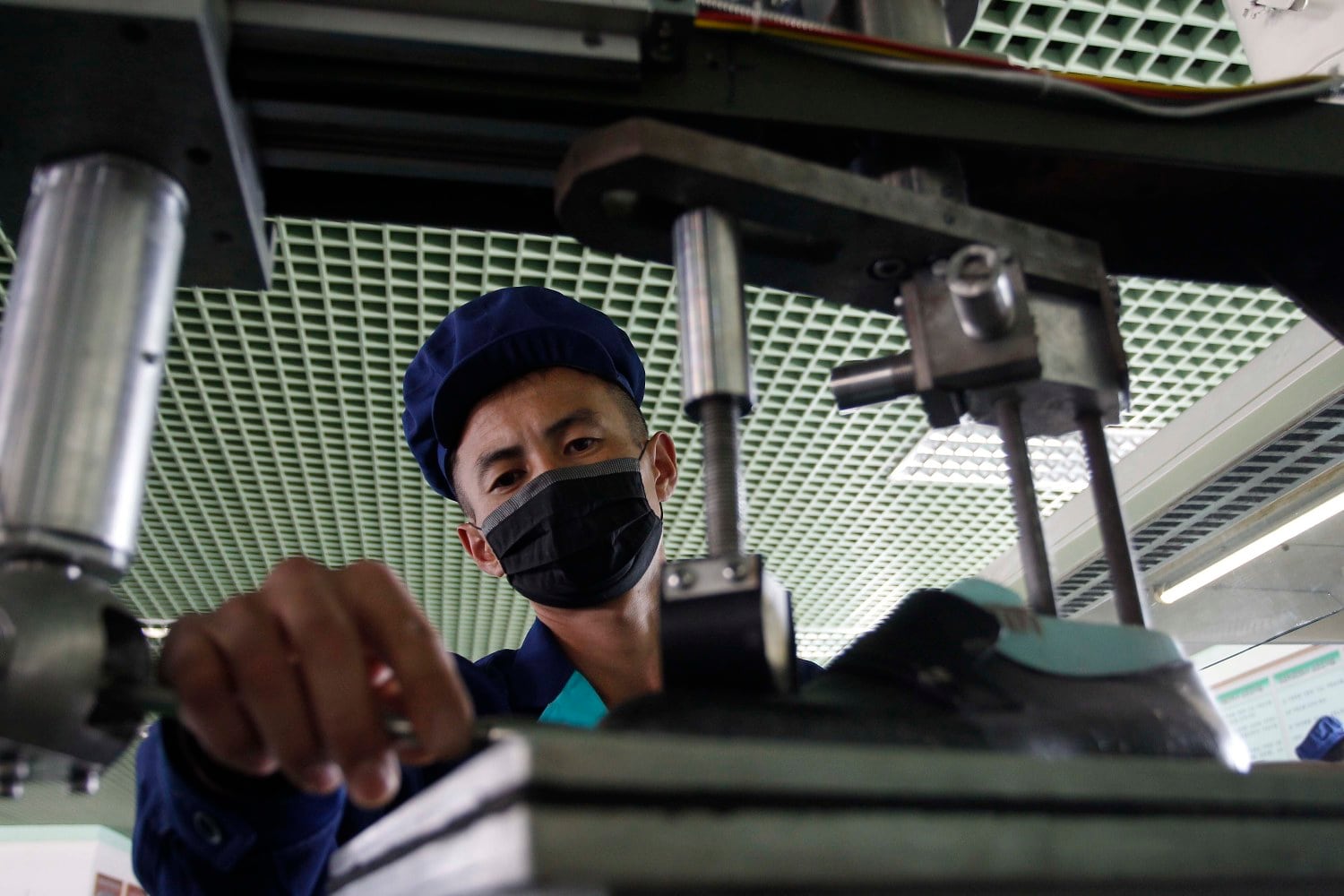
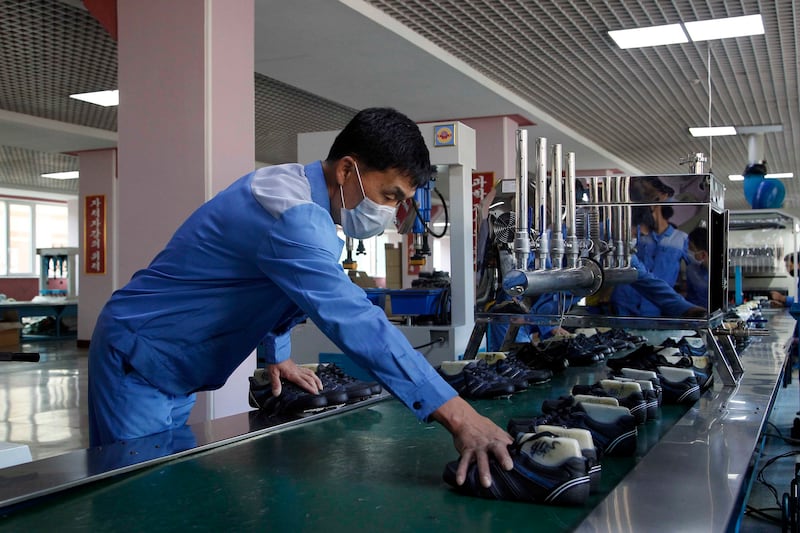
Last month’s take-home pay for Mr. Kim – a 45-year old man who works a government-assigned job in a state-run food processing plant in South Pyongan province – was 20,000 won (about 30 US cents). Although his official wage is set at 50,000 won a month, 30,000 won was deducted upfront as “social support” for state construction projects, education funds, and agricultural supply purchases.
Because production levels and management vary widely across industries and state enterprises in North Korea, worker compensation differs significantly. While well-managed, profitable factories pay higher wages, struggling facilities cannot guarantee even baseline monthly compensation.
Mr. Kim was fortunate to receive any pay at all this month – raw materials arrived on time, keeping his factory’s assembly line running. Workers at other plants were not as lucky. They received nothing when supply shortages ground operations to a halt.
Even though he is one of the lucky ones who got paid, a 20,000-won income cannot buy a single kilogram (2.2 pounds) of white rice – currently priced at over 40,000 won per kilogram – or even a kilogram of corn, which costs around 25,000 won.
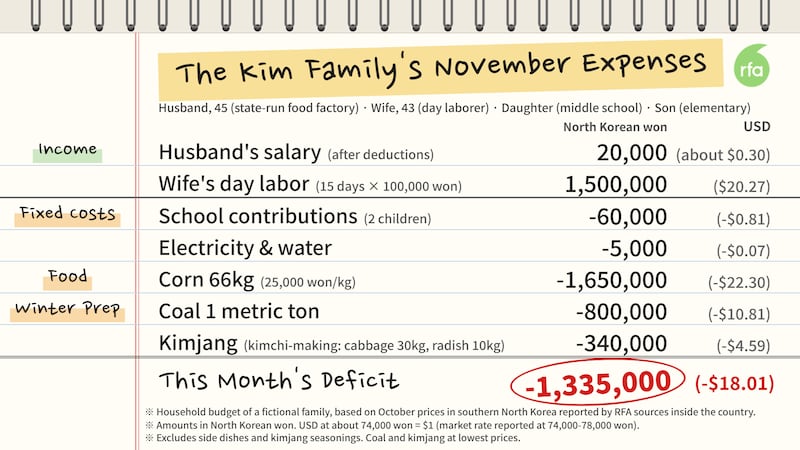
Based on October price and wage data verified through sources inside North Korea, RFA compiled a monthly budget for a composite four-member household—comprising factory worker Mr. Kim, his wife Ms. Lee, and their two school-aged children—to illustrate the reality of monthly living expenses.
The reported commodity prices were gathered from South and North Pyongan, South and North Hwanghae, and Kangwon provinces.
Starting each month ‘in the red’
With two children attending school, the Kim household budget starts in the red every month.
Schools demand children bring “assignment quotas” of waste paper and scrap metal for recycling – it is a mandatory patriotic offering. Collecting the materials takes a lot of time and effort, so most students pay in cash instead – to the tune of around 30,000 won per month. With two kids, that’s 60,000 won, already triple Mr. Kim’s salary.
On top of that, home utilities cost roughly 5,000 won per month. Even though water and electricity can and do cut out at any given moment, they still have to pay the bill.
Thus the Kim family is already 45,000 won in the hole before factoring in the cost of food.
In some factories, 5 to 10 kilograms (about 10-20 pounds) of corn is said to be supplied to working employees once a month, while in North Hamgyong Province, the rice or prepared food items that were previously provided have been completely cut off. Circumstances differ depending on the region, factory, and enterprise, but at any rate, what families are provided through their workplaces is a mere fraction of what they need to eat each month.
According to the daily food recommendations set by North Korean authorities – 750 grams of corn for workers, 550 grams for housewives and 450 grams for students, the monthly food requirement based on three meals per day for the Kims is about 66 kilograms.
1.65 million corn deficit. Rice? Keep dreaming
How much money does the Kim family need just to scrape by each month?
According to sources, as of October, the price of white rice traded in North and South Pyongan provinces is about 40,000 won per kilogram, and corn is around 25,000 won. In North Hamgyong and Ryanggang provinces, 1 kilogram of white rice has already exceeded 50,000 won.
If the family relied entirely on white rice, their monthly food bill would reach 2.64 million won—equivalent to 52 months of Mr. Kim’s nominal salary of 50,000 won. Rice is therefore a luxury that only the wealthiest North Koreans can afford. Like most North Koreans, the Kims will get by on a diet of mostly corn. A monthly supply costs a total 1.65 million won, which is 33 times Mr. Kim’s nominal monthly income.
Jiro Ishimaru, head of the Osaka-based ASIAPRESS media outlet that covers North Korea, explained, “Currently, with a North Korean worker’s salary, rice is out of the question, and they barely live centered around corn.” Asiapress tracks commodity and food prices in various regions through its contacts in North Korea.
“In the case of working at a state enterprise, it varies by rank and industry, but roughly the monthly pay provided by the state is between 35,000 won and 100,000 won,” he said. “Even if a well-performing state enterprise pays double the salary at 200,000 won, with that money you cannot even buy 5 kilograms of white rice, and there is no such thing as rations. With such wages, people are barely able to live on a diet centered on corn.”
Under these constraints, balanced meals with adequate protein remain an unaffordable luxury. Pork sells for 270,000 won per kilogram—more than 13 times Mr. Kim’s take-home wage – pollack costs 100,000 won per kilogram, and eggs sell for 10,000 won each.
Other important food-related items are also out of reach. Bottled water runs between 5,000 and 10,000 won per liter, and a 10-liter container of imported Russian cooking oil costs 200,000 to 250,000 won. Although prices vary by quality and region, such items remain entirely unattainable on a 20,000-won salary.
Adding basic daily necessities, staple food supplies like condiments, and transportation expenses, the growing deficit is only made worse when unexpected expenses arise.
So the family somehow needs to earn more money to get by.
Side hustles to feed the family
Like most other families, the Kims need side hustles to bridge the gap between Mr. Kim’s income and their monthly living costs. Ms. Lee used to trade goods in the marketplace to earn money, but then the government started cracking down on informal market activity. Now she has turned to day labor, hauling heavy loads or doing manual labor at construction sites. According to sources, the daily wages people earn from this sort of work can be about 100,000 - 200,000 won. In one day of manual labor, she earns double what her husband earns working a full month at the factory.
However, informal work is irregular. Even if Ms. Lee secures 15 days of labor a month and brings in 1.5 million won, her earnings still fall short of covering the 1.65 million won needed just to buy monthly corn supplies.
Ishimaru explained that there are other types of jobs that people can get to bridge the gap.
“Since official salaries alone are not enough, as all our contacts tell us now, assembling products at home—like wigs or eyelashes—serve as side jobs,” said Ishimaru. .
In October 2023, when North Korean authorities drastically increased the legal monthly wages of state enterprise workers, office staff, and civil servants by at least 10 to over 20 times, most North Korean residents welcomed it. Expectations were high that they could eat three meals a day and enjoy basic living, but in just 3 to 4 years, massive inflation caused by shortages, and currency devaluation hit the public economy hard.
RFA sources reported that most workers do not expect wages to serve as a means of livelihood, pointing out the severe gap between state-fixed wages and individual day labor. They criticized North Korea as “socialist in appearance, but more capitalist than actual capitalism.”
Winter brings high coal costs
In November, an even bigger crisis is facing the Kim household: heat. Coal prices have skyrocketed to 800,000–900,000 won per ton, more than quadruple the cost just six years ago.
In North Korea, a four-member household usually needs at minimum 1 to 1.5 metric tons of coal to get through winter. To actually be warm, they need at least 3 metric tons, but the Kims decided to stick to minimal heating. Preparing firewood for the winter should have started back in the summer, but Mr. Kim, burdened with monthly budget deficits and struggling just to put food on the table, had no time to spare.
Families must also prepare food supplies to get them through the winter, and this has traditionally been done through kimjang, where families gather together and make large amounts of kimchi – enough to last through the colder half of the year.
Sources told RFA that the vegetables that go into kimchi are expensive: napa cabbage currently costs 9,000 to 10,000 won per kilogram, while radishes cost 7,000 to 8,000 won per kilogram. While a family of four typically needs around 300 kilograms of cabbage for the season, the Kim household plans to prepare a minimal batch of 30 kilograms of cabbage kimchi and 10 kilograms of radish kimchi without extra seasonings. Even this reduced batch costs at least 340,000 won, driving the family deeper into debt.
Sources estimate that a four-person household in North Korea needs approximately $80 to $100 USD (roughly 5.9 million to 7.8 million North Korean won) per month for baseline survival, yet ordinary residents operate on less than half that amount. Even if Ms. Lee works day labor and side jobs all month to earn 3 million won, the family still reaches only half of the required subsistence threshold.
RFA asked Mr. Ishimaru how ordinary North Korean families manage to survive under persistent deficits.
“I’m really curious too. Truly curious,” Ishimaru said. “Residents in provincial cities live under very difficult conditions. Everyone assesses that life was much more comfortable before 2019, … when individual economic activities were possible.”
To make matters worse, sources project that as usual, grain prices will rise again starting in December as the worst months of winter roll in. Mr. Kim will continue working at the factory to receive 20,000 won. To cover the deficit budget of their 4-member family, his wife Ms. Lee will have to find unofficial work at 100,000 won a day for at least half the month of December to make ends meet, even on their family’s tightened budget.
Edited by Noh Jung Min in Korean and by Charlie Dharapak and Eugene Whong in English.