
Read a version of this story in Korean.
North Korea’s push to build increasingly large warships could pose new security challenges for South Korea and the United States, but questions remain over whether Pyongyang has the military capabilities and financial resources to operate the ships effectively, security experts told Radio Free Asia.
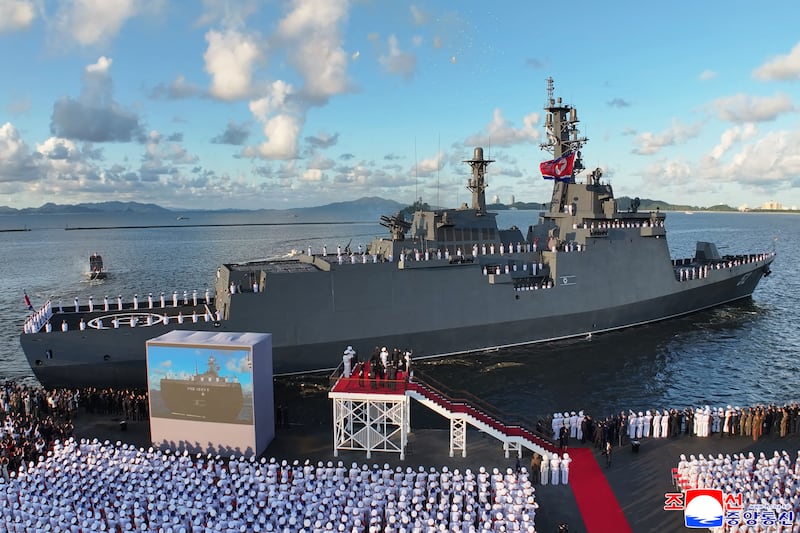
North Korea’s leader Kim Jong Un has made naval modernization a priority, commissioning two 5,000-ton destroyers this year while pursuing even larger surface combatants.
The first destroyer, the Choe Hyon, entered service in June, followed by the Kang Kon in September. During a Nov. 2 visit to the Nampo shipyard, southwest of the capital Pyongyang, Kim inspected what state media described as an enormous new warship, with photographs revealing part of its lower hull.
The destroyers mark a significant departure from North Korea’s traditionally coastal-focused navy, which has relied heavily on smaller vessels. The new larger ships are designed to carry a wider range of weapons, including missiles capable of striking targets at greater distances.
North Korea also conducted tests of new torpedoes in October and November, underscoring Pyongyang’s efforts to expand its naval capabilities.
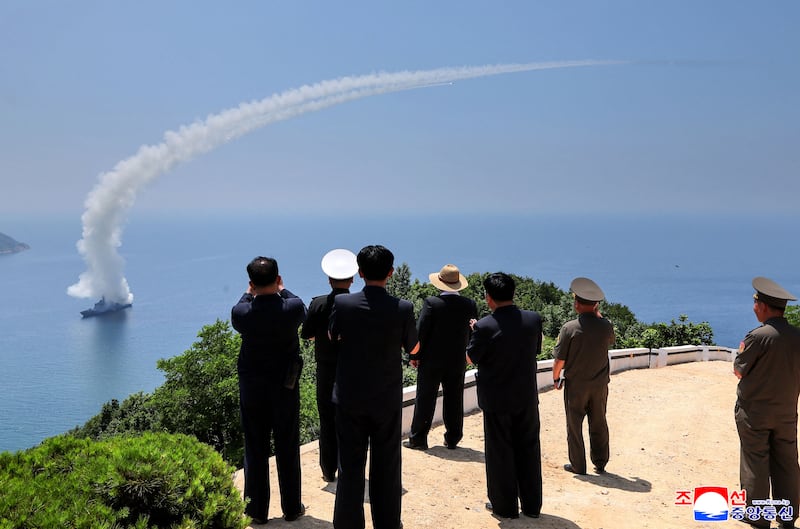
Unlike land-based missile launchers, warships can move across large maritime areas, potentially giving North Korea more options for launching strikes and complicating efforts to track nuclear weapons within the isolated country.
Bruce Bennett, a former senior researcher at the California-based RAND Corporation, told RFA Korean that the destroyers could add another dimension to North Korea’s nuclear threat.
“North Korea is diversifying its means for delivering nuclear weapons. … Its destroyers are designed to carry nuclear weapons, and they will likely do so as part of this diversification process,” said Bennett. “By doing so, it hopes to make it very difficult for the United States to carry out a disarming attack on its nuclear forces. It will have too many targets of too many different types.”
A senior officer in Japan’s Maritime Self-Defense Force, who spoke to RFA Korean on condition of anonymity, also said the destroyers could carry tactical nuclear weapons, increasing the threat posed by Pyongyang’s expanding fleet.
The officer noted that North Korea had likely relied on Chinese and Russian technology to build the destroyers, which appear to be beyond its existing capabilities.
The destroyers’ hulls resemble China’s Type 052D Luyang III-class destroyers, while their radar systems resemble those of Russia’s Admiral Gorshkov-class frigates, suggesting Pyongyang may have drawn on Chinese shipbuilding expertise and Russian weapons technology, according to the officer.
Despite their potential threat, however, the vessels face significant operational limitations, particularly against aircraft and submarines, the officer said.
“Large surface vessels are exposed to threats from the air and underwater. Surface warships cannot operate independently,” the officer said.
Modern naval operations require multiple layers of protection, including onboard air defense systems, early warning aircraft and fighter jets capable of intercepting incoming threats.
North Korea tested an airborne early warning aircraft in March 2025, but South Korea’s Joint Chiefs of Staff said at the time that its operational threat remained limited despite potential improvements in surveillance capabilities.
Pyongyang’s fighter fleet also faces disadvantages. In December 2024, U.S. Indo-Pacific Command chief Adm. Samuel Paparo raised the possibility that North Korea could acquire MiG-29 and Su-27 fighter jets.
However, both are fourth-generation aircraft that would face significant challenges against the more advanced fifth-generation F-35 fighters operated by South Korea and the United States, potentially limiting Pyongyang’s ability to protect its warships.
The Japanese officer also questioned the destroyers’ ability to counter submarines, particularly in the complex waters east of the Korean Peninsula.
“The Sea of Japan is an extremely difficult area in which to detect submarines because of its complex currents and salinity distribution,” said the officer, referring to the body of water east of the Korean Peninsula, also known as the East Sea.
“Without combining patrol aircraft such as the P-3C or P-8, it is impossible to locate submarines. North Korean destroyers would not be able to defend themselves against submarine attacks.”
The officer added that even stealth-designed warships could be quickly detected by satellites or high-altitude reconnaissance drones.
Political ambitions and mounting costs
Despite those challenges, Kim appears determined to build vessels even larger than Choe Hyon and Kang Kon, reflecting a longstanding North Korean ambition to develop a powerful navy.
That ambition dates back to the reign of Kim’s late grandfather, national founder Kim Il Sung. Pyongyang has long viewed its naval inferiority as a strategic disadvantage, believing it left the country unable to challenge the Northern Limit Line, a disputed maritime boundary established by the U.N. Command after the 1953 Korean War armistice, that places several islands near North Korea’s shore under South Korean control.
But a Japanese government official, who spoke to RFA Korean on condition of anonymity, suggested the younger Kim’s pursuit of increasingly large vessels may reflect personal ambition rather than purely military requirements.
“This may reflect Chairman Kim’s personal desire to possess enormous warships,” the official said.
The official argued that North Korea’s centralized political system could encourage military planners to prioritize the leader’s preferences over operational considerations.
“I believe Kim – who aspires to match countries such as South Korea and the United States – has become fixated on building impressive-looking large warships, so he has issued orders that disregard military rationality,” the official said.
The official added that North Korean military officers and engineers faced pressure to satisfy the leadership, with those opposing Kim’s views risking punishment.
Lee Hyun-ju, who was once Seoul’s consul general in Osaka and who previously headed the South Korean office of the Korean Peninsula Energy Development Organization, or KEDO, told RFA that military officers in North Korea know that the wisest course of action is to demonstrate loyalty and respect toward Kim Jong Un.
“They also know that displaying intense hatred and aggression toward anyone who insults the supreme leader is the safest approach,” he added.
Beyond their operational limitations, the warships could impose substantial financial costs on North Korea’s economy.
The expense comes as North Korea continues to face international sanctions imposed over its nuclear and missile programs, restricting its access to foreign markets and technology.
According to Japan Self-Defense Forces officials, building a 5,000-ton destroyer would cost at least 50 billion yen (US$314.2 million), even after accounting for the country’s relatively low labor costs.
That would be roughly equivalent to North Korea’s total exports in 2024, according to the officials’ estimate.
“Building a destroyer also requires spending on maintenance, repairs and other operating costs,” a Self-Defense Forces official told RFA Korean. “This would represent a considerable burden for North Korea.”
Edited by Taejun Kang and Eugene Whong.


