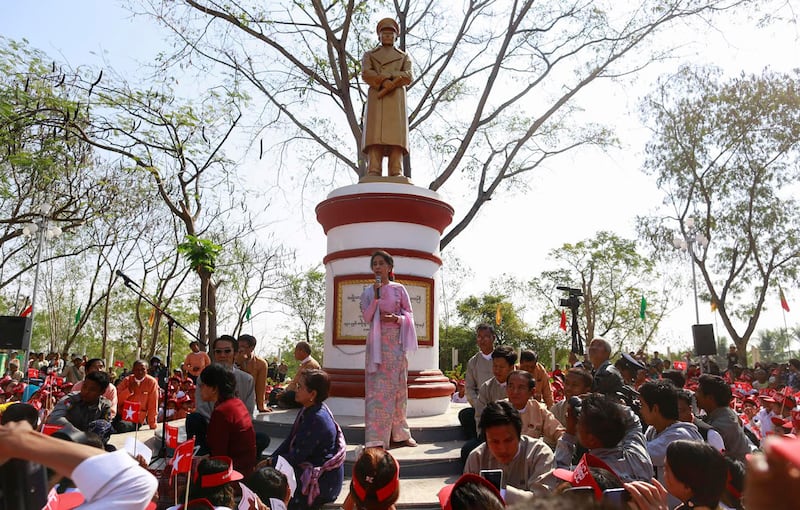
Myanmar’s military-backed government removed or destroyed at least 15 statues of Gen. Aung San, who led the country to independence from British rule and was the father of jailed former State Counselor Aung San Suu Kyi, residents tell Radio Free Asia.
Since former general Min Aung Hlaing was sworn in as Myanmar’s new president in April, the removal of statues of Aung San in public areas have increased in Magway, Bago, Yangon, Ayeyarwady, Sagaing, and Mandalay regions, according to an RFA tally.
In June, authorities demolished a bronze Aung San statue in Zee Kone, Bago Region. On July 1, officials demolished one statue in Mya Kan Thar Park in Thaketa Township and two statues in Thumingalar Park in South Okkalapa Township, Yangon, fencing them off. Residents tell RFA government authorities are monitoring the sites so that no one can take photos.
The military-backed government took issue with media reports including one published Thursday by RFA Burmese that documented the disappearance of the statues.
“Some media outlets are currently reporting the removal of General Aung San statues in certain areas. In reality, not all statues of General Aung San are being removed; rather, only statues with incorrect proportions and shapes are being reviewed and handled in accordance with the law,” said government spokesperson Khaing Khaing Soe in a statement published on Friday.
For months, the military-backed government hadn’t commented on why the statues were being removed.
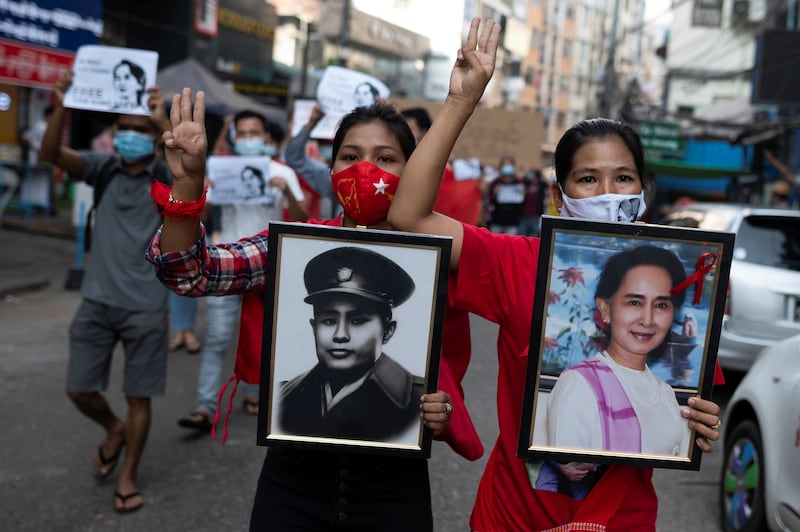
Statues of Gen. Aung San were erected around the country between 2015 and 2020 during the government led by Aung San Suu Kyi’s National League for Democracy, or NLD. In a July 8 statement the NLD said that it had participated in the construction of the statues in accordance with the will of the people and with the contributions of individual citizens in accordance with the law.
They are destroying his statues “because Gen. Aung San left his daughter Aung San Suu Kyi for the Burmese people,” said Bo Bo Oo, a vice chairman of the NLD. “The dictator... is attacking the statues as well as oppressing the citizens,” he said, referring to Min Aung Hlaing.
“Nevertheless, Aung San will always be in the hearts of the people.”
A politician from Tharyarwady, who did not want to be named for security reasons, criticized the wiping of Gen. Aung San’s image from public display, including de-circulating banknotes with his image, as an act of successive military dictatorships.
“Gen. Aung San was erased from the public eye for several years, resulting in the boom and rebirth of his role in history in recent administrations, starting from the Thein Sein government to the time of ‘our mother’ Aung San Suu Kyi, from vinyl pictures to papers. And finally during the rule of Aung San Suu Kyi, there have been many statues of the general. There have been many in every neighborhood and city.”
He said that so many statues of Aung San felt like a “punch to the gut” for many of the previous military leaders.
Government officials announced that a special exhibition will be held at the General Aung San Residence Museum in Natmauk, Magway region, for the Martyrs’ Day celebration on July 19, and that the public is welcome to visit.
“Gen. Aung San is a very important figure in the history of Myanmar’s independence struggle,” government spokesperson Khaing Khaing Soe said in a statement.
“Therefore, in order to ensure that the statues of the general are kept in accordance with their dignity, and that future generations can study and preserve the historical value and tradition correctly, they are being reviewed in accordance with The Protection and Preservation of Ancient Monuments Law 1962.”
Translated by Kyaw Min Htun. Edited by Charlie Dharapak and Eugene Whong.