
Taiwan’s plan to open a second trade office in the Philippines is an example of Manila and Taipei accelerating cooperation in response to Chinese pressure in the South China Sea, analysts told Radio Free Asia.
During a radio interview on Sept. 15, Taiwan’s Foreign Minister Lin Chia-lung said that Taipei’s plan to open a second representative office in Cebu, the Philippines’ second largest city, was going smoothly.
Taipei’s trade offices serve as de facto embassies and consulates in countries that officially recognize China, but maintain unofficial relations with Taiwan, which Beijing considers to be a rogue province.
Foreign Minister Lin said that the additional trade office would serve travelers and businesses in the central Philippines, and would be an integral part of a proposed Taiwan-Philippines Economic Corridor.
Days later, Taiwan confirmed that it had donated a decommissioned patrol vessel to the Philippines for use in its coast guard.
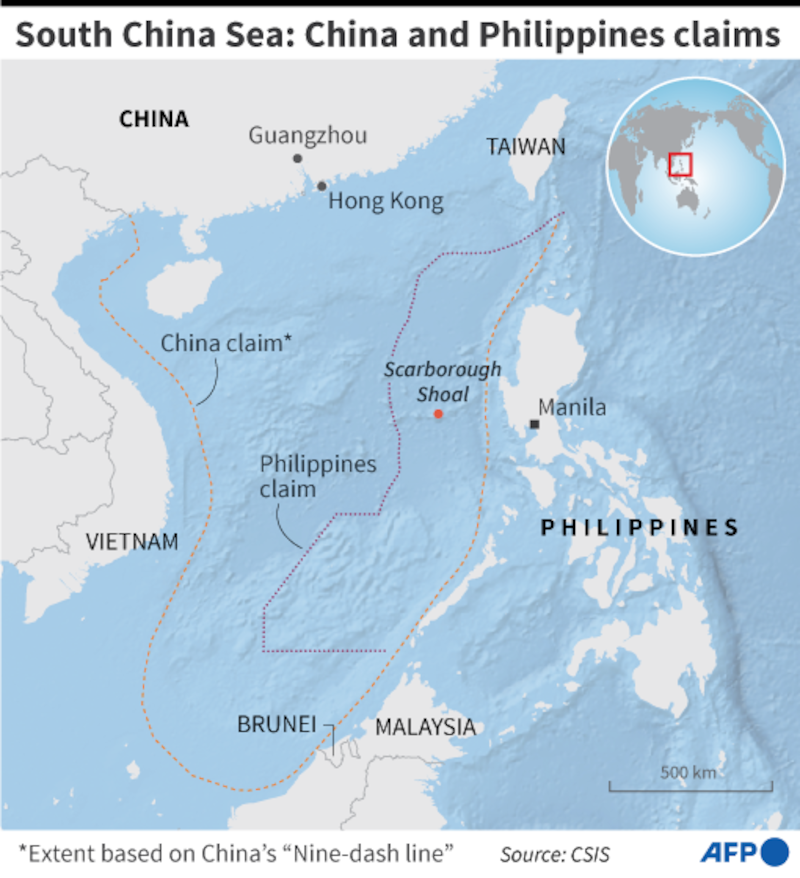
These developments are directly related to Beijing’s hostile tactics in the South China Sea, Ray Powell, executive director of Stanford University’s SeaLight maritime transparency project, told RFA. Beijing claims the entirety of the sea as its territory, including the area within the Philippines’ exclusive economic zone, which Manila calls the West Philippine Sea.
“Of course China’s aggression in the West Philippine Sea is a central part of this story,” said Powell. “It has made Manila less willing to grant Beijing the kind of deference that other countries like Malaysia or Papua New Guinea have recently been so eager to show on Taiwan policy.”
Papua New Guinea announced in July that it would close the Taiwan trade office in Port Moresby, and Malaysia’s Prime Minister Ibrahim Anwar in August controversially stated in an interview with Al Jazeera that he sees “Taiwan as part of China, period.”
The trend of smaller countries showing deference to China “has conditioned Beijing to expect that its coercive methods will always produce compliance eventually,” Powell said. “For now at least it has not produced that kind of result in the Philippines.”
Defining “one China”
As a condition of entering into official relations with China, countries must affirm that there is one China and recognize Beijing as the sole legal government of China.
China’s official stance, the one-China principle, states that Taiwan is an inalienable part of China. Many countries maintain their own one-China policies that stop short of the principle to allow unofficial ties with Taipei.
When Taiwan announced the plan to open a new trade office in Cebu, Beijing protested, with Chinese Foreign Ministry spokesperson Guo Jiakun urging the Philippines to uphold the one-China Principle through “concrete actions” and refrain from taking steps that could damage relations with China.
“No matter how the DPP authorities collude with external forces or in what form they seek so-called ‘diplomatic breakthroughs,’ their efforts to serve the goal of ‘Taiwan independence’ are doomed to be futile,” Guo said, referring to Taiwan’s ruling Democratic Progressive Party.
The Philippine Department of Foreign Affairs responded that Manila’s one-China policy remained unchanged but did not prevent economic, cultural and functional cooperation with Taiwan.
Philippine Defense Secretary Gilberto Teodoro Jr. was more direct, telling local media: “We define the one-China policy. We define it. Not them.”
The exchange highlights a widening difference between Manila and Beijing over what the Philippines’ one-China policy allows.
The Taiwan trade office in Cebu should not be interpreted as a change in Manila’s formal position, Joseph Kristanto, a research analyst at Singapore’s S. Rajaratnam School of International Studies, told RFA.
“Rather, I think it reflects the ongoing expansion and institutionalization of the Philippines’ unofficial and functional relationship with Taiwan,” he said. “This distinction is important: Manila continues to recognize Beijing as the sole legal government of China under its one-China Policy, yet it does not view this policy as precluding economic, cultural, or other practical forms of engagement with Taiwan.”
That relationship had already begun expanding before the latest dispute.
In April 2025, Philippines President Ferdinand Marcos Jr.’s administration relaxed decades-old restrictions on engagement with Taiwan. Most Philippine officials may now travel there for economic, trade and investment purposes if they use ordinary passports and do not use their official titles.
The restrictions continue to apply to the president, vice president, foreign secretary and defense secretary, illustrating the line Manila is trying to maintain between functional engagement and steps that might resemble formal diplomatic recognition.
“Currently, Manila appears intent on maintaining a distinction between expanding functional ties and taking actions that could be construed as formal diplomatic recognition,” Kristanto said. “The 2025 guidelines are particularly illustrative: they facilitate interactions with Taiwan for economic and investment purposes while retaining restrictions on contacts involving the Philippines’ most senior officials.”
Economic interdependence
Practical interests are also driving the relationship. More than 200,000 Filipinos work in Taiwan, and the two sides offer visa-free entry to each other’s citizens. Taipei has also placed greater emphasis on trade, investment, tourism and supply-chain cooperation with the Philippines.
Foreign Minister Lin said the proposed Taiwan-Philippines Economic Corridor would connect with the U.S.-Japan-Philippines-backed Luzon Economic Corridor, an initiative aimed at strengthening infrastructure and supply chains.
Kristanto cautioned against explaining the closer relationship entirely through the South China Sea dispute.
“The deterioration in Manila-Beijing relations has certainly made Taiwan more strategically relevant to the Philippines, and we have seen indications of expanding practical cooperation in areas such as maritime security,” he said.
“But many drivers of closer Philippines-Taiwan relations – economic links, labor, geographical proximity, and supply-chain cooperation – exist independently of the South China Sea dispute. I therefore see pressure from China more as an accelerant to an existing trend than as its sole cause.”
Powell said the Philippines increasingly viewed China’s treatment of Taiwan as part of a wider effort to pressure smaller countries that resisted Beijing’s preferred regional order.
“There’s an active attempt by China, very obvious now, to make a more Sinocentric world and to put down others who do not agree with them – particularly when these others are smaller countries,” Powell said, quoting from a recent SeaLight podcast interview with Teodoro.
Kristanto said the significance of the Cebu office lay less in the facility itself than in Manila’s growing confidence in defining its relationship with Taipei on its own terms.
“Manila appears increasingly willing to insist that maintaining a one-China policy does not give Beijing a veto over its unofficial relationship with Taiwan,” Kristanto said.
“So, in my view, the significance of the Cebu office lies less in the office itself than in what it tells us about how much more comfortable Manila has become in expanding ties with Taiwan while arguing that its formal diplomatic position remains unchanged.”
Edited by Eugene Whong.