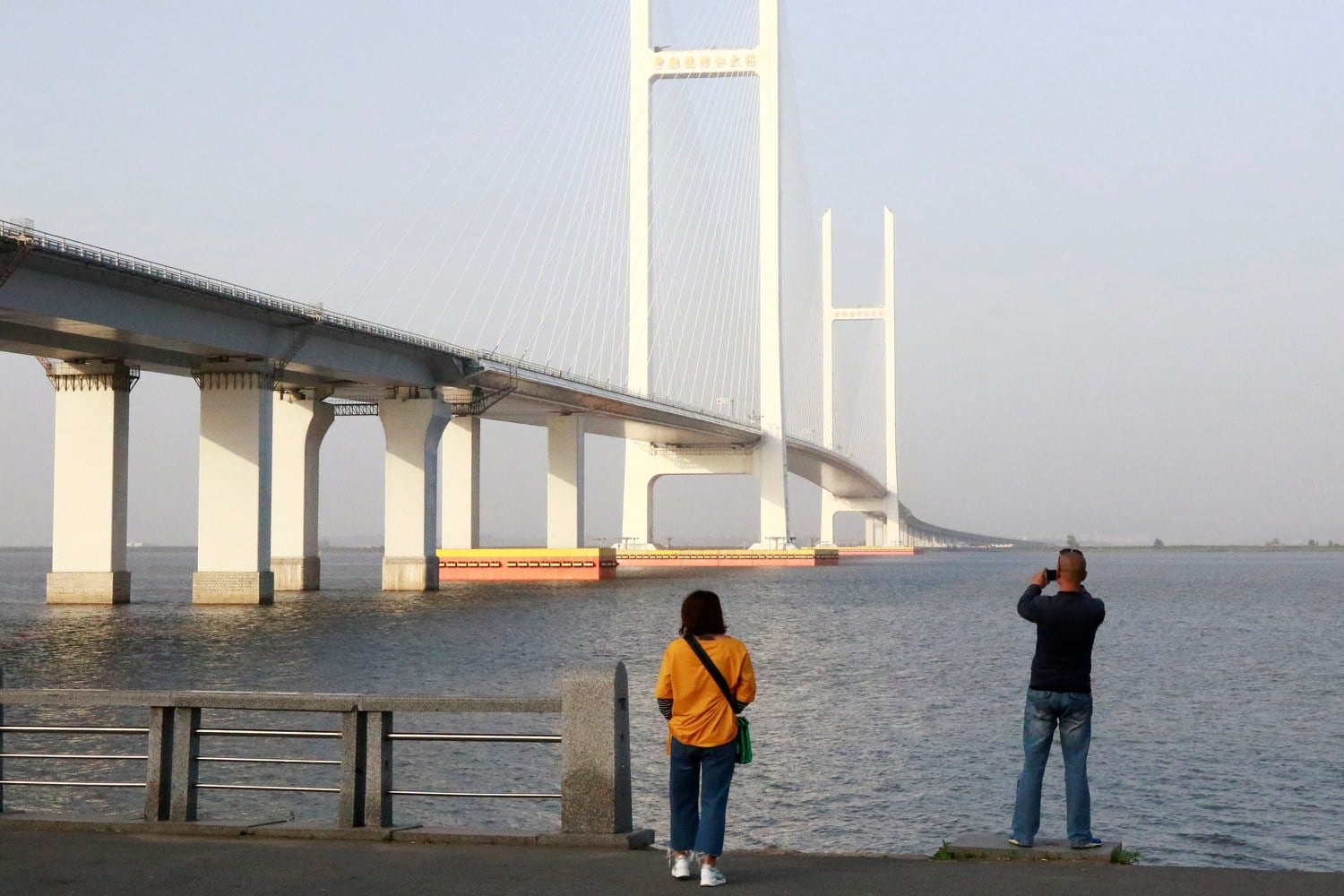
North Korea is close to completing a long-delayed new bridge to China, satellite imagery analyzed by Radio Free Asia shows.
Experts said that once the new bridge connecting Dandong in China with Sinuiju in North Korea is complete, trade volume will more than double, relieving pressure on the aging Sino-Korean Friendship Bridge – the only other connection between the two cities – considered the main artery between the two countries.
Pyongyang and Beijing completed the structure of the New Yalu River Bridge in 2014, with the Chinese government footing the bill, but since then it has remained unopened because the two sides could not come to an agreement on financing construction on infrastructure facilities on North Korea’s end.
But construction resumed in January 2025 after Chinese firms agreed to invest, and if all goes according to plan, the new bridge could go into service as early as autumn, Bruce Songhak Chung, a senior researcher at the Seoul-based Korea Institute for Security Strategy, told RFA.
“Chinese traders involved in cross-border commerce said discussions on an opening ceremony could be held once construction on the North Korean side is completed,” Park Jongchol, a professor at Gyeongsang National University in South Korea said. “On the Chinese side, there were a few predicted dates being discussed — such as October 3, the date the two countries established diplomatic relations — though these have not been confirmed by either Beijing or Pyongyang.”
Even if that prediction ends up being incorrect, Chung said he expects the bridge to open this year based on his assessment of the imagery.
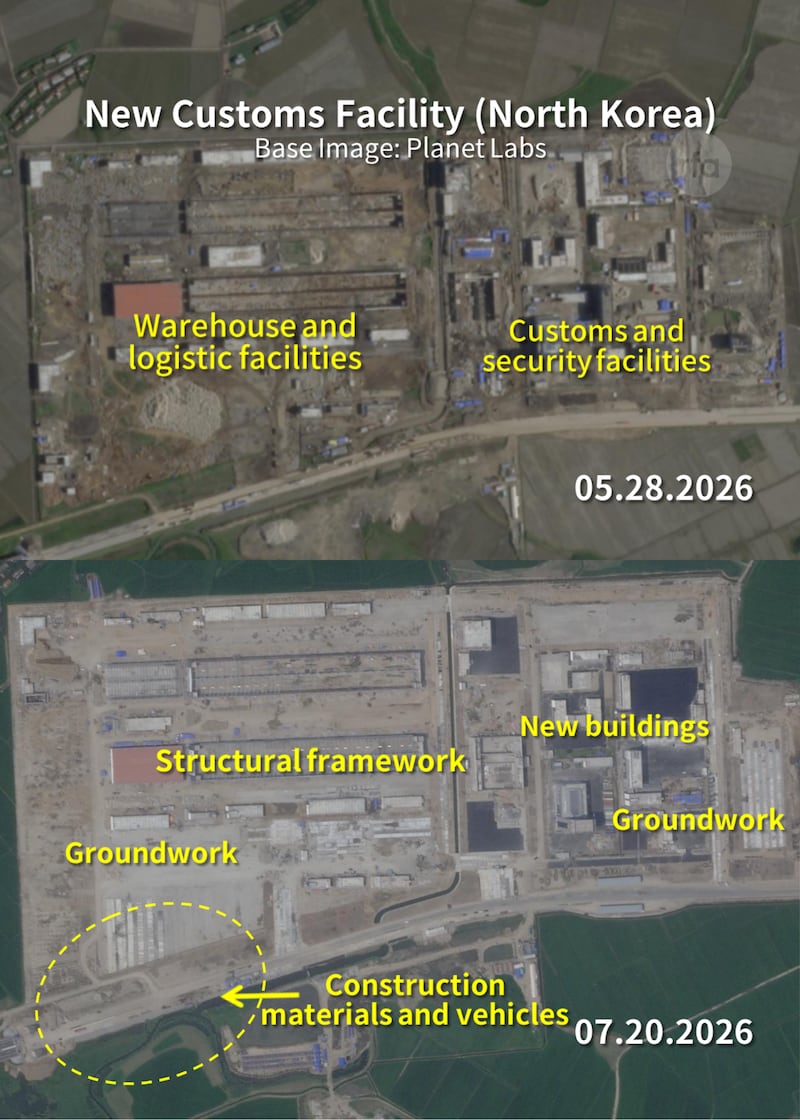
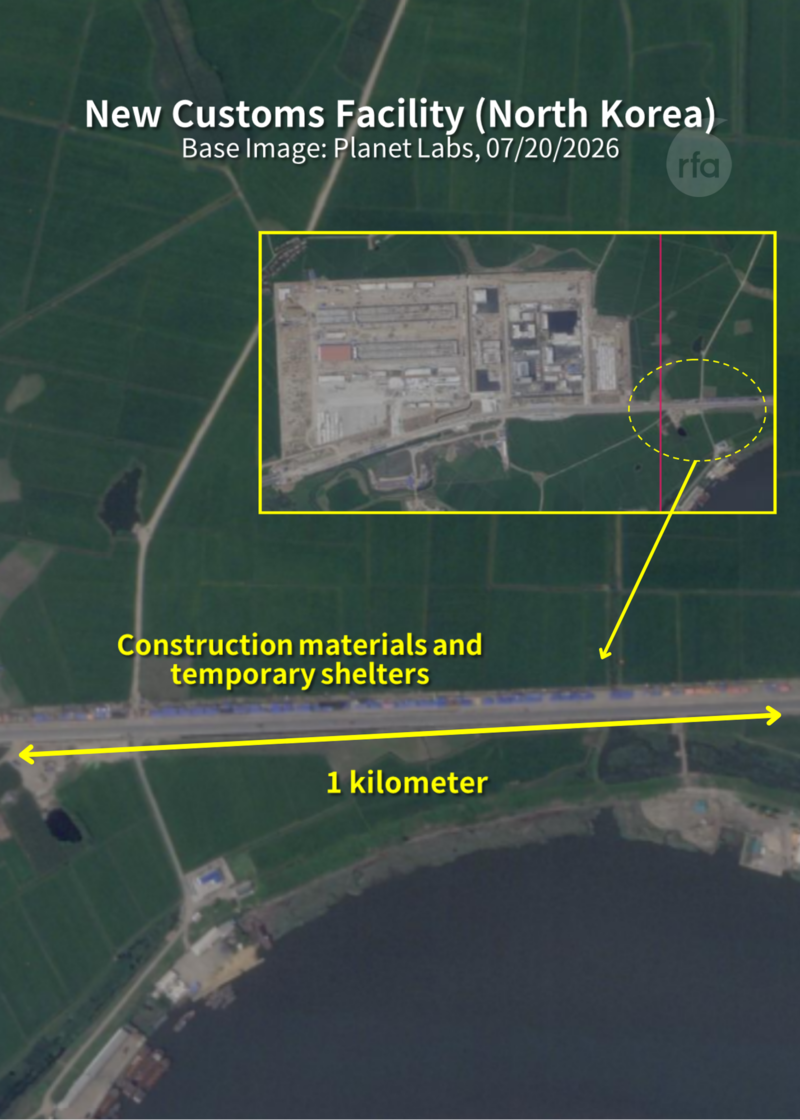
In a July 20 image, construction has advanced significantly in both the warehouse and logistic zone and the customs and security zone on the North Korean side of the bridge, Chung said.
These are located in a roughly 50-hectare (120-acre) area that was cleared and left undeveloped for more than a decade. Since the 2025 restart, dozens of administrative and security buildings, warehouses, and other facilities have been erected, with roofs installed and exterior structures largely completed, the imagery shows.
Closer ties, increased trade
As construction progressed, Chinese President Xi Jinping visited North Korea on June 8 and agreed with North Korean leader Kim Jong Un to expand economic cooperation and make greater use of cross-border trade in areas including agriculture, technology, infrastructure, and people-to-people exchange.
Chinese experts suggested that following Xi’s visit, Beijing is expected to provide a large package of gifts to North Korea, with the bridge just a small part of it, Park said.
The bridge itself was to have been a symbol of economic cooperation between the two countries, but instead it became one of the better-known North Korean white elephants, built for a glorious national purpose, but serving no function. But that will change once it opens.
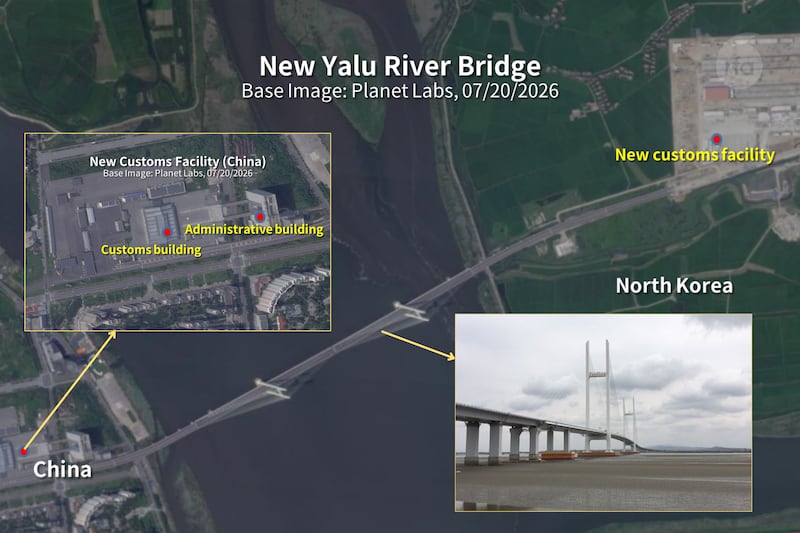
The new bridge will allow direct access for heavy cargo trucks, increase customs capacity, lower transportation costs and support development of Sinuiju, Joung Eunlee, the director of the Seoul-based Korea Institute for National Unification, told RFA.
“The bridge aligns with broader economic interests on both sides of the border,” she said. “China has sought to strengthen Dandong’s position as its principal trade gateway with North Korea, while Pyongyang is expected to increase imports of construction materials and industrial equipment for infrastructure and regional development projects.”
Final touches
In recent months, construction has continued at a breakneck pace, Chung observed.
“Along the northern access road to the bridge, satellite imagery also identified construction materials and temporary shelters for workers, the blue and orange objects visible along the roadside for more than one kilometer—supporting work on the customs complex and road paving,” Chung said.
However, paving inside the customs complex and on access roads has yet to be completed, indicating the ground preparation and foundation work are still underway. So the final asphalt or concrete paving, lane marking and site cleanup must be completed before the customs facility can support regular freight clearance and vehicle traffic, Chung said.
Construction on the North Korean side of the bridge is visible from China, Park told RFA.
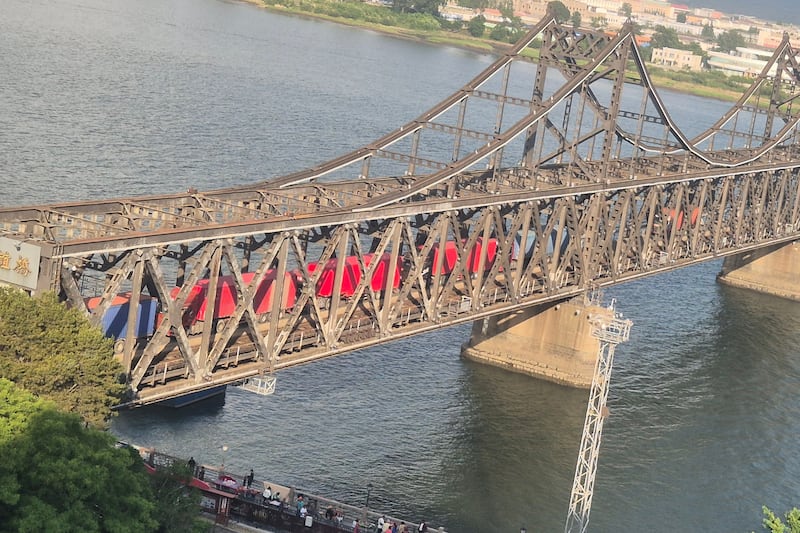
“Vehicles continue to carry construction materials across the bridge. It is expected to open this year,” Park told RFA.
The bridge stretches about 3 kilometers (1.9 miles) from the customs facility on the Chinese side into North Korea, and the four-lane highway has now been fully paved in both directions. On June 28, Seoul-based media outlet Daily NK reported that buses have been seen conducting trial runs across it.
Park said he was able to observe about 300 trucks crossing from China into North Korea and roughly the same number crossing back in the afternoon over the aging Sino-Korean Friendship Bridge, which lies just upstream from the new bridge.
The Friendship Bridge was built by the Japanese during World War II, making it older than North Korea itself. Because roughly 70% of Sino-North Korean trade traverses this bridge each year, but it was built for a different era, and can handle only a limited number of crossings per day, Park said.
“Once the new bridge opens, cargo volume is expected to increase several times over, dramatically transforming cross border logistics,” Park said.
Tumen bridge behind schedule
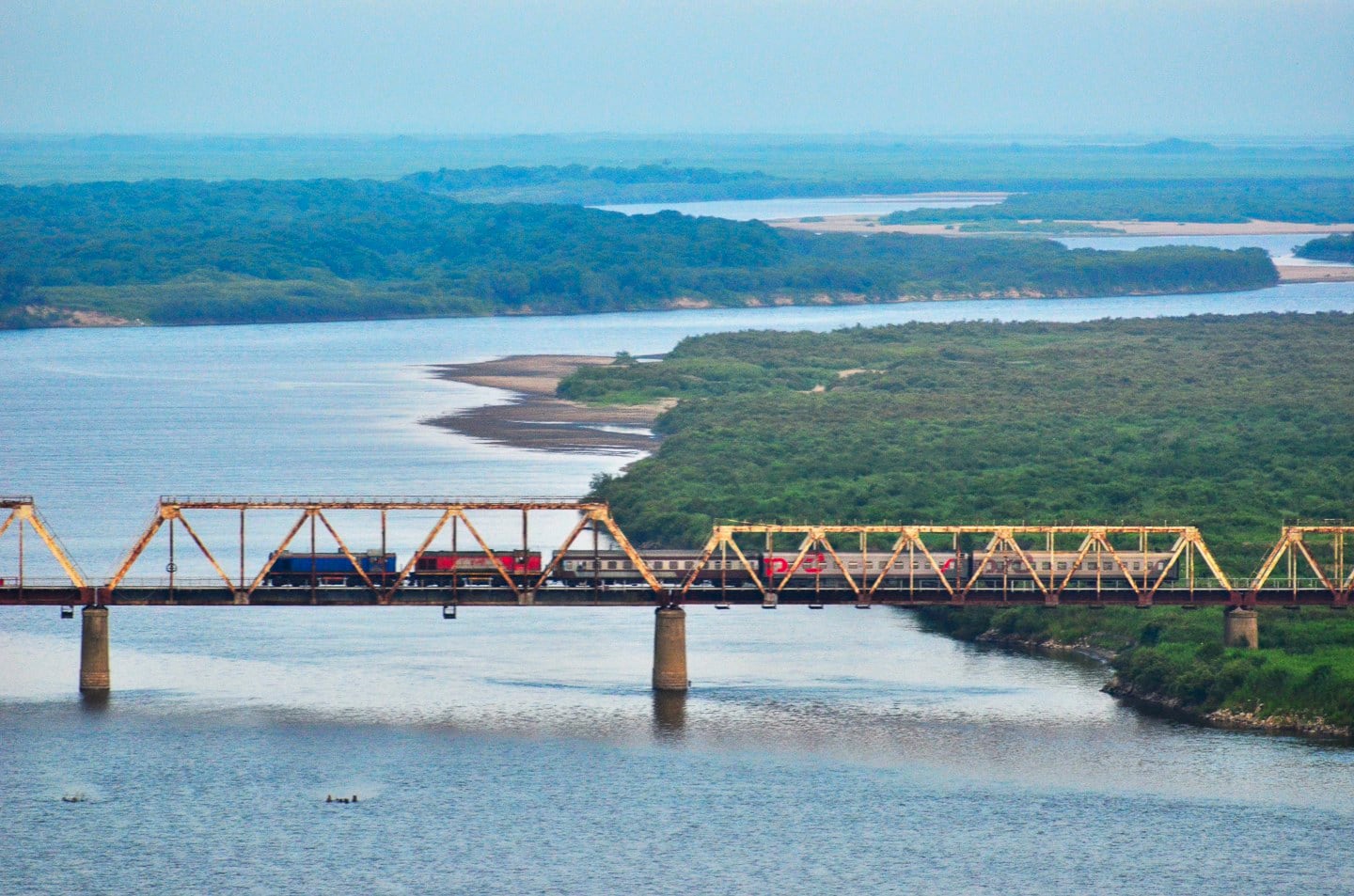
Meanwhile, satellite imagery indicates that construction on the Tumen River Bridge connecting North Korea and Russia — which had reportedly been expected to open on June 19 — is still underway.
Satellite imagery captured June 30 shows construction on the bridge itself, plus North Korea’s customs facility and access roads, has been completed. But work on the Russian side, including roads, a checkpoint and a customs complex, remains unfinished.
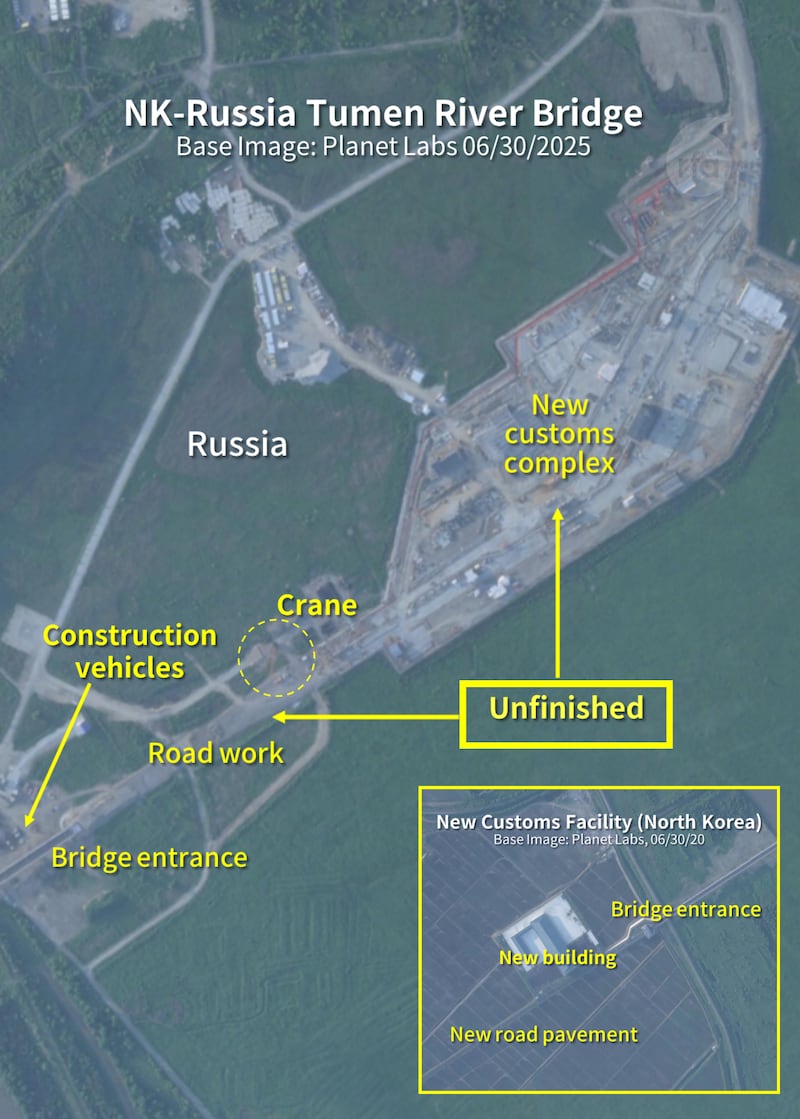
The roughly 1-kilometer (0.6-mile) bridge will connect the North Korean city of Rason with the Russian town of Khasan and will be capable of handling up to 300 vehicles and 2,850 people per day, according to Russia’s Ministry of Transport.
Despite the delay, Russian President Vladimir Putin Monday met with North Korea’s Foreign Minister Choe Sun Hui, emphasizing close ties between two countries.
Experts told RFA that the new bridges may provide a means for China to undercut international sanctions on North Korea, meant to deprive Pyongyang of cash and resources that could be funneled into its nuclear and missile programs.
Russia was the first to openly violate sanctions on North Korea, Joung said. Moscow needed allies as it faced increased isolation following its invasion of Ukraine in 2022.
Entities in China, on the other hand have found ways to get around sanctions, such as by transferring goods ship to ship while at sea, or by setting up shell companies to obfuscate where goods or money are sent and received, Joung noted.
The bridges would make it even easier for Moscow and Beijing to skirt sanctions without meaningful international oversight or enforcement, regulated only by the health of their relationship with Pyongyang, she said.
“The New Yalu River Bridge and the Tumen River Bridge seem to be one of the barometers of North Korea’s relations with China and Russia,” Joung said. “Both bridges are expected to open this year, and diplomatic ties and economic cooperation between North Korea and China, North Korea and Russia, and among all three countries are likely to be stronger than ever.”
Edited by Eugene Whong.