On May 22, 2018, China Central Television broadcast a glowing segment about salmon farming in western China. Over images of sleek fish cutting through clear water, the narrator marveled that “a precious fish like salmon, which typically lives in the open ocean,” could now be raised in the desert. Technology had made the improbable possible. “The land is the same land, and the people are the same people,” the program declared, “but when technology is brought in, miracles are born.”
Viewers were unconvinced and immediately began voicing skepticism about seafood coming from such a surprising place. Within days, Chinese social-media users questioned whether the fish on screen was actually salmon at all. “People expect Atlantic salmon, but we’re getting freshwater rainbow trout that costs half as much,” one Beijing-based WeChat account complained. “How could you not be angry?” The science writer Fang Shimin put it bluntly: “This is cheap rainbow trout being passed off as expensive salmon.”
Where the media campaign had hoped to tell a bigger and more hopeful story about the success of farming in a place most people thought was impossible, the public reaction veered in a different direction. China has rapidly expanded its fish farms in its historically restive and inland west—erecting more than 1,000 in Tibet and Xinjiang—motivated by a slate of priorities including food security, settling a nomadic and politically volatile population, poverty alleviation, and reducing fishing pressure on its polluted eastern shores.
The state-led media campaign around China’s desert seafood also sought to redirect Western attention away from human rights abuses that are pervasive in these two Chinese regions. The growth of these farms in China’s west is the focus of a sweeping investigation by The Outlaw Ocean Project, a news organization in Washington, DC, which showed how much seafood from Xinjiang is reaching the U.S., including government facilities, in violation of the Uyghur Forced Labor Prevention Act.
The backlash over rainbow trout was not only about unfair prices, but also about questions of food safety. In a 2018 interview with China Daily, food safety expert Zhong Kai reacted to Chinese companies advertising salmon that was actually trout. He advised that eating freshwater trout raw, as one would eat salmon, could lead to serious illness.
China’s aquaculture industry has expanded at staggering speed, and with that expansion have come the familiar pressures of industrial animal farming: crowding, disease, waste, and chemical intervention. Chinese researchers have increasingly found illegal quantities of drugs in farmed fish, including antibiotics and sedatives at levels that threaten humans.
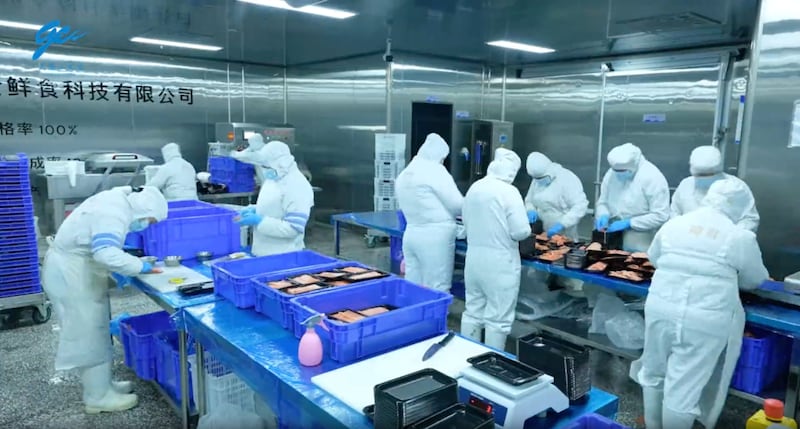
These food safety questions are relevant outside of China. One company, called Xinjiang Tianyun Organic Agriculture, now ships to 14 countries, including the U.S., where its products are sold at Walmart and served at American schools, prisons, and military bases. This trade occurs in violation of a U.S. ban on goods produced in Xinjiang or by ethnic minorities from the region, which Congress enacted in 2021 after finding human rights abuses to be pervasive and severe there. Tianyun’s seafood reaches the U.S. by way of supplier deals with Aqua Star and Sysco, according to Bait to Plate, an online tool that tracks the fishing and seafood industries.
Tianyun said in a statement that claims of systemic forced labor “are completely factually unfounded” and described the U.S. ban as unreasonable and politically motivated. The company added that it strictly abides by China’s laws on labor and contracts. Aqua Star did not reply to a request for comment. Walmart confirmed that it sources seafood from Aqua Star. Sysco said it expects its suppliers to follow all U.S., international, and local laws and that they suspend contracts when they do not.
The Chinese efforts to promote seafood from Xinjiang are not new. As early as 2011, Vice Minister of Agriculture Niu Dun urged officials to “enhance brand building and awareness of the market expansion of Xinjiang’s seafood enterprises.” A 2017 government action plan instructed local offices to coordinate with mainstream media to “systematically publicize the progress of fishery poverty alleviation” in Xinjiang, fostering “an environment of positive public opinion.”
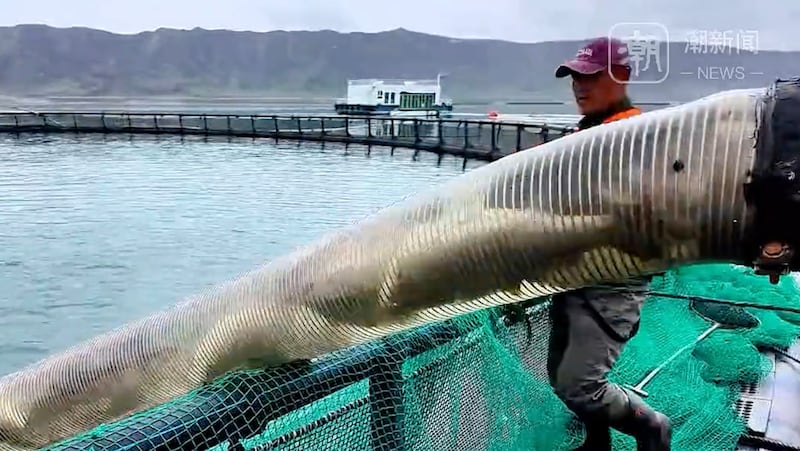
This marketing push intensified in August 2023 when there was a sharp spike in social media posts on the topic. The hashtag “No joke—Xinjiang really does produce seafood” climbed Weibo’s Hot Search List. Videos associated with “Xinjiang seafood” amassed millions of views. Soon, the theme leapt beyond China’s own internet. YouTube, which is banned in China, saw a sharp rise in Xinjiang seafood videos that fall.
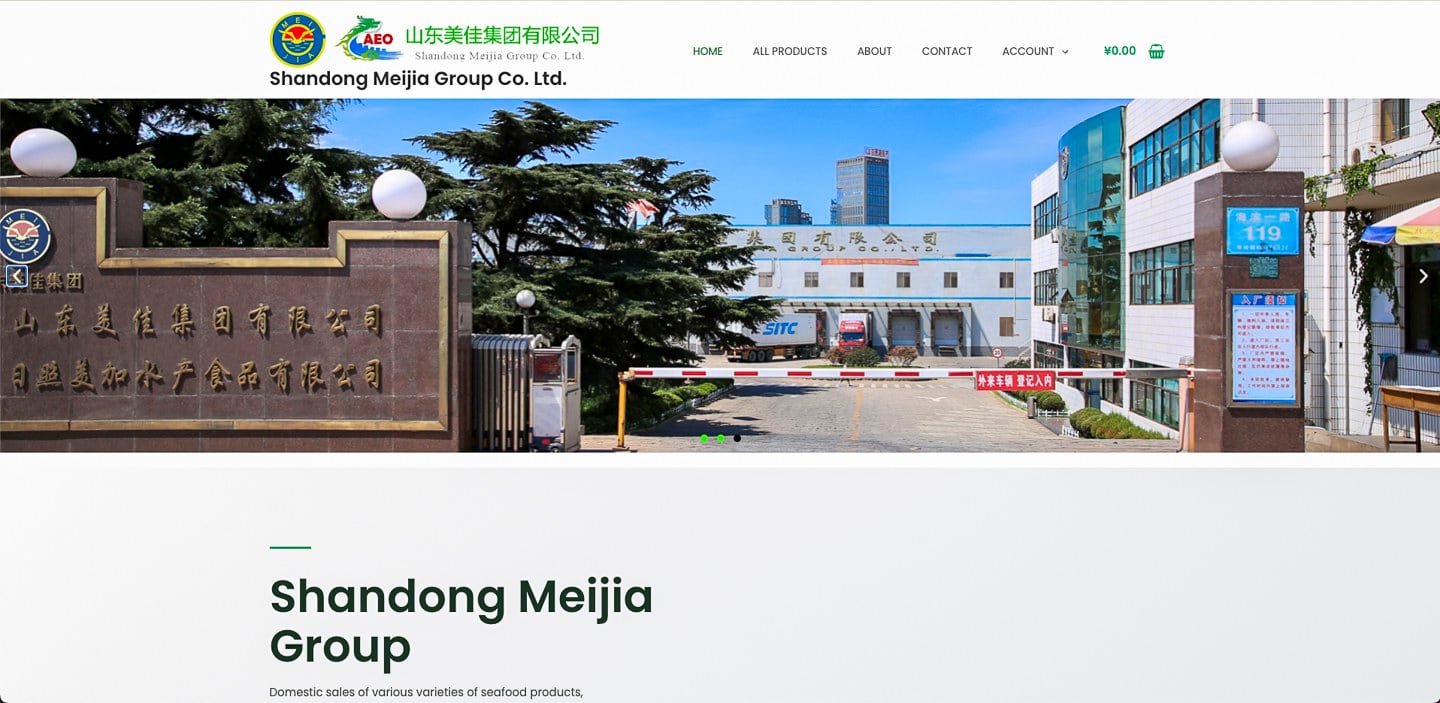
“All signs point to this being a coordinated campaign,” said Fergus Ryan, a senior analyst at the Australian Strategic Policy Institute. He explained that it had unusual speed and reach due to top-down and algorithmic amplification, unlike natural viral events, which typically grow slowly through grassroots sharing. In his view, the campaign served to redirect attention from mounting international scrutiny after a 2023 investigation found that seafood plants in Shandong had used thousands of Xinjiang labor transfers to process fish destined for major Western markets. Against that backdrop, Ryan argued, the upbeat Xinjiang seafood videos functioned as a kind of information flooding, crowding search and recommendation systems with stories of “fishery miracles” rather than forced labor.
China is using other tactics to prevent companies from insulating themselves from these sorts of human rights abuses. In April 2026, the government announced new rules that would make it even more difficult for multinationals to conduct due diligence on supply chains in industries like seafood and cotton.
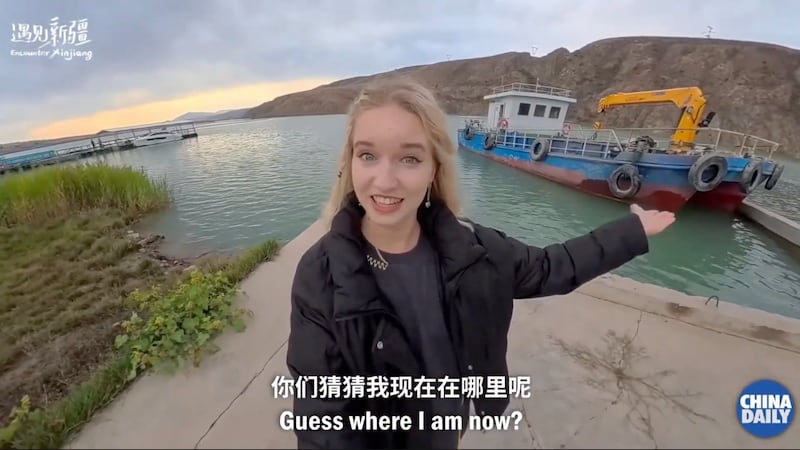
Part of the same effort, the Chinese government has also organized media tours for foreign reporters and actively recruited foreign food buffs—called vloggers or “frontier influencers”—to record and post videos and other testimonials about the wonders of growing fish in Xinjiang.
Among the most popular frontier influencers is a Russian student named Melissa. “Today, we’ve come to a salmon farm in Nilka, Xinjiang, to be an employee for a day and see what it’s like for ourselves,” she said in a video published in September 2025. These videos were amplified by media outlets affiliated with the government, as well as on state-run channels on YouTube and Facebook. A video featuring Jack, an American vlogger, showcased his tour of a fish farm on the edge of the desert. “It’s incredible how they have developed such a barren land to this extent,” he narrated.
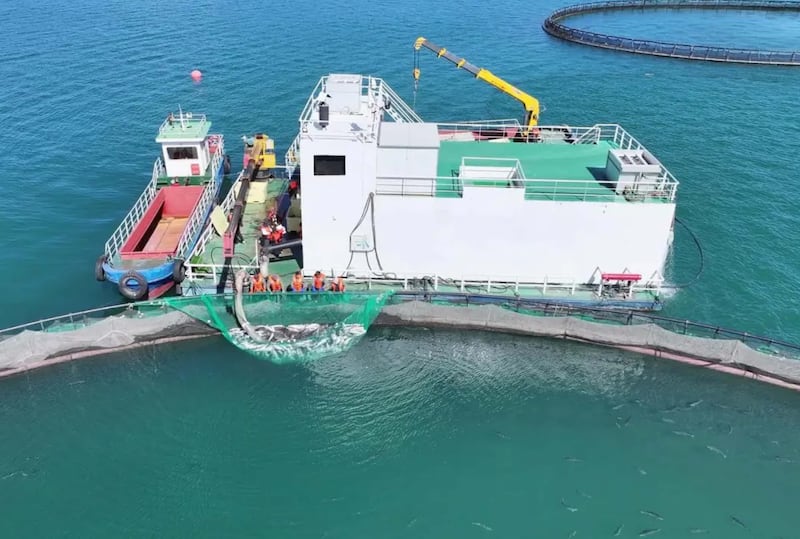
But it is the government itself that attempts to frame the unlikely industry it has engineered in Xinjiang in the grandest terms. In a 2025 article published by state media, Xinjiang’s aquaculture hotbed in the deserts and rivers of its forbidding western frontier was declared “a testament to human ingenuity and resilience.”
“Xinjiang’s aquaculture is not merely about producing fish,” the article went on, “it is about reimagining how inland regions can contribute to the nation’s protein security, how technology can redefine agriculture, and how harmony between people and nature can be sustained in the most challenging of environments. From snow-fed rivers to desert oases, Xinjiang has shown that blue dreams can indeed flourish on dry land.”
This commentary is based on reporting for a larger investigation conducted by an international team of journalists based at The Outlaw Ocean Project.
The Outlaw Ocean Project is a non-profit journalism organization based in Washington D.C. that produces investigative stories about human rights, labor, and environmental concerns.
The views expressed here are their own and do not reflect the position of RFA.