
A rare visit by Taiwan’s coast guard minister to Taiping Island is part of Taipei’s strategy to assert its claim over the disputed South China Sea outpost and a move taken right out of Beijing’s “gray zone” playbook, analysts told Radio Free Asia.
Taiwan’s Ocean Affairs Council Minister Kuan Bi-ling travelled last month to Taiping Island, where she oversaw exercises officially framed as humanitarian operations.
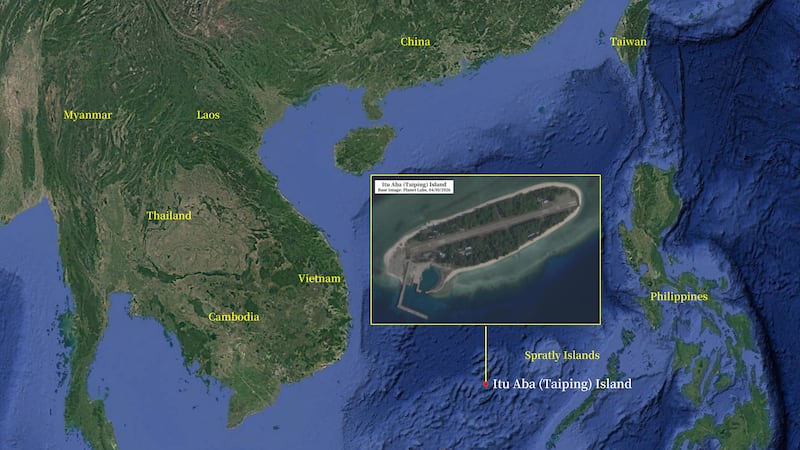
Also known as Itu Aba, Taiping is Taiwan’s only holding in the hotly contested Spratly Islands, strategically located in a resource-rich part of the South China Sea, and at the center of shipping lanes traversed by trillions of dollars in trade each year.
China has increasingly used gray zone tactics – provocative actions by non-military entities such as its coast guard – to project its power in the Spratlys and other areas of the South China Sea, and the Taiwanese minister’s visit seems to be along the same lines, the analysts said.


During Taiwan’s first ministerial visit to Taiping in seven years, Kuan oversaw operations officially framed as humanitarian exercises, but footage also showed a drill where heavily armed coast guard personnel practiced boarding a cargo ship “trespassing” in what Taipei claims are its territorial waters.
Signaling without escalation
The use of the coast guard in this manner blurs the line between civilian law enforcement and military activity, William Yang, a Northeast Asia analyst at the Belgium-based International Crisis Group think tank, told RFA.
“By framing the exercise as ‘humanitarian,’ Taiwan seeks to strike a balance between enhancing its coast guard’s capabilities and avoiding prompting a direct, aggressive response from China,” he said, adding that the inclusion of the armed boarding drill reflects a push to expand the role of law enforcement as part of Taipei’s claim.
Taiwan has long maintained a garrison on Taiping, also claimed by China, Vietnam and the Philippines, but the inclusion of coast guard actions there marks a shift in signalling, Aadil Brar, a Taipei-based independent analyst and former visiting scholar at the National Chengchi University, told RFA.
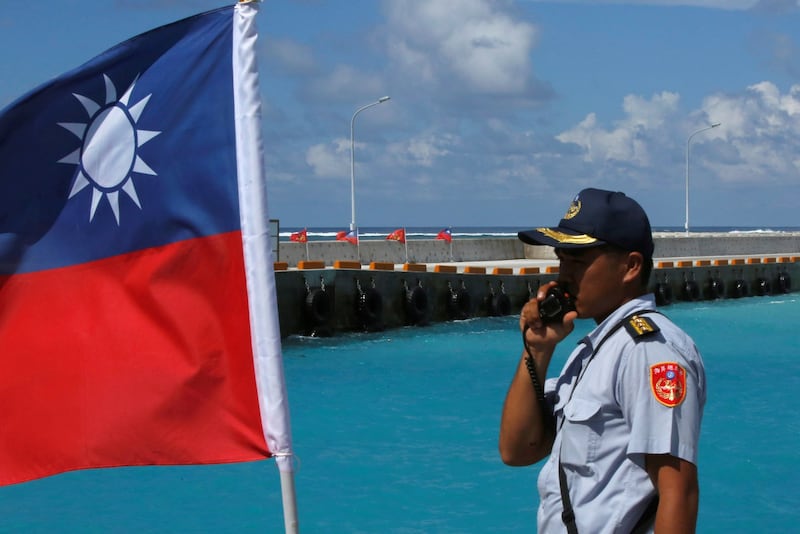
“I’d frame it as a deliberate intensification rather than a clean break from existing policy,” said Brar. “When you have the first ministerial visit to the island in seven years, with Ocean Affairs Minister Kuan Bi-ling physically present on the ground, you’re looking at a clear political signal layered on top of routine military activity.”
Brar noted that the participation of a coast guard special task unit and the release of video footage showing an armed boarding operation suggested Taipei “wanted this to be seen,” describing it as “a calculated assertiveness” in Taiwan’s posture.
The timing also coincided with heightened military activity across the region, including the large-scale joint “Balikatan” exercises between the United States and the Philippines, and increased Chinese naval deployments.
“Taiwan is essentially positioning itself as an active stakeholder in that moment, not a passive observer,” Brar said.
Spratly significance
The Spratly Islands are the focal point of overlapping territorial claims by China, Taiwan, Vietnam, the Philippines, Malaysia and Brunei.
Taiping Island is the largest naturally formed feature in the Spratlys and it has a runway capable of handling military resupply aircraft. A recently upgraded wharf there can accommodate large patrol vessels, though it remains lightly defended compared to the heavily fortified Chinese-controlled outposts nearby.
For Taiwan, the island represents its only foothold in asserting claims in the South China Sea, giving added weight to Taipei’s efforts to demonstrate both presence and governance.
In a 2016 case brought by the Philippines challenging the legitimacy of the nine-dash-line drawn by China to assert its claims over almost the entire South China Sea, the Permanent Court of Arbitration ruled in favor of the Philippines, declaring China’s line had no basis in international law.
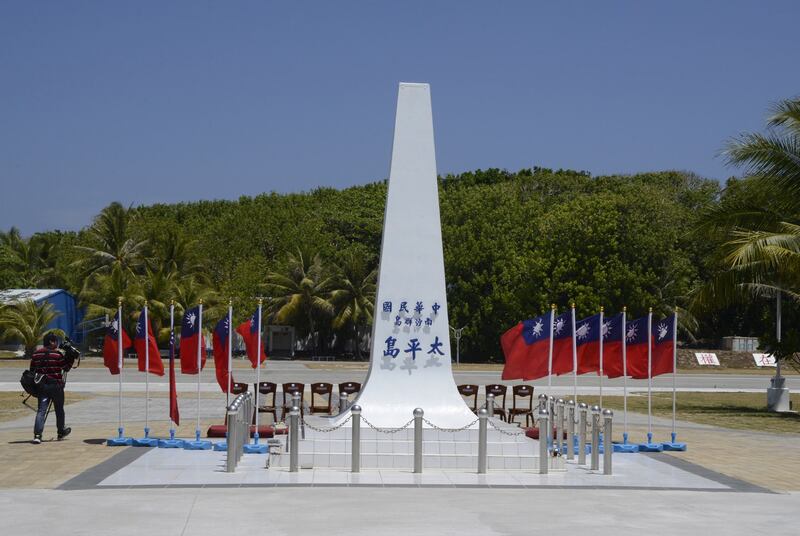
That ruling, however, qualified Taiping only as a “rock” under the U.N. Convention on the Law of the Sea, because it was not able to sustain human life or economic activity on its own.
It meant that even if Taiwan were to have undisputed sovereignty over Taiping, its non-island status would limit the territory that could be claimed in its exclusive economic zone, so Taiwan rejects this finding.
Analysts told RFA the visit is also aimed at proving that the island is more than a rock, reinforcing Taiwan’s claim that it is an island with normal administrative functions.
Coast guard gray zone
Taiwan’s coast guard is increasing coordination with its navy to more effectively counter Chinese claims, Yang said.
“As China continues to assert its territorial claims across the South China Sea, Taipei understands that it also needs to step up its involvement in defending its control over Itu Aba,” he said.
Brar said the use of coast guard forces offers Taipei a strategic advantage.
“The coast guard is the ideal instrument,” he said. “It sits in a legally ambiguous space – it’s not the navy, so activating it doesn’t constitute a militarised act under most international frameworks, but it carries weapons, operates with tactical discipline, and can enforce jurisdiction.”
That allows Taiwan to project deterrence while limiting the risk of escalation, he said, describing the approach as “textbook gray-zone operation design.”
Despite the calibrated nature of such actions, the growing reliance on coast guards to assert claims carries risks.
Vietnam protested Kuan’s visit, saying any foreign activities in the Spratlys without its consent infringe on its sovereignty, stressing how even non-military operations can inflame tensions.
As more countries expand the scope of their coast guard operations, analysts warn that there may be less distinction between civilian and military activity, raising the risk of miscalculation.
Still, Taiwan appears to be betting that carefully staged shows of presence – framed as humanitarian and law enforcement missions – can strengthen its position without crossing thresholds that would provoke a direct response from Beijing, Brar said.
“That’s gray-zone strategy in its most refined form,” he said. “You change facts on the ground and shift psychological perception, all while the other side struggles to find a legitimate counter-move that doesn’t cost them more than it costs you.”
Edited by Eugene Whong.