
MANILA - If Philippine Vice President Sara Duterte accepted funds from Beijing to grant political favors, it would fall directly within standard operating procedures for Chinese foreign influence operations, a Philippine military official told Radio Free Asia.
The remarks came after prosecutors in the vice president’s impeachment trial presented evidence of the alleged corruption – a financial forensics accountant testified that Cale88 Foods Corp., controlled by Duterte and her husband Manases Carpio, received 319 million pesos (US$5 million) from state-run Chinese firms. Duterte said the allegations were politically motivated.
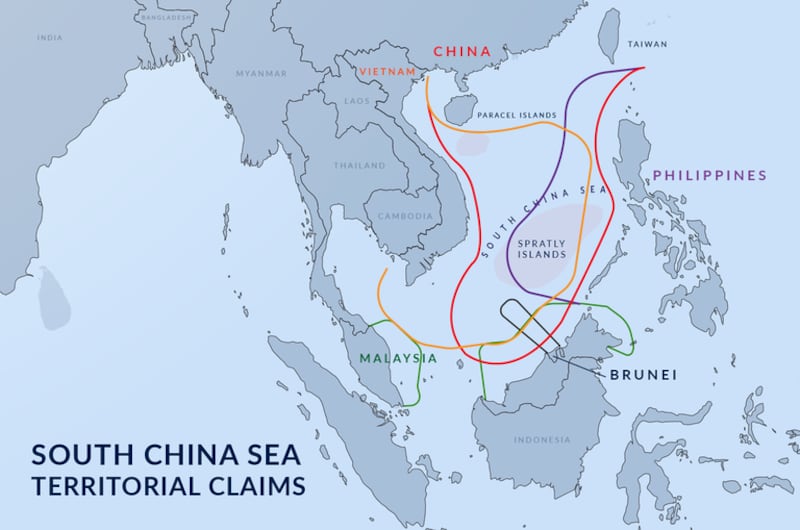
The revelations raised alarm bells, with Filipino officials and experts immediately raising the specter of Chinese spy and malign influence operations as the two countries have become locked in an increasingly tense territorial dispute in the South China Sea, parts of which are claimed by Manila and referred to as the West Philippine Sea.
Gaining access to the most influential people in a target country is a fundamental malign influence strategy for Beijing, retired Rear Adm. Roy Vincent Trinidad, spokesman for the Philippine military in the West Philippine Sea, told RFA.
“Part of the rulebook of the Chinese Communist Party includes economic elite co-optation and political elite co-optation,” Trinidad told RFA. “If they could co-opt a political leader, have him elected by building him up politically through foreign malign influence, they would have achieved the objective without firing a single shot.”
While donations or grants by any government are not illegal per se and are governed by rules, if the supposed investments are “used to advance the position of our adversary…it will have very serious national security implications,” Trinidad said.
“When another country would like to occupy your territory, would like to sow false narratives to advance their interests, they are creating trouble not only domestically, but in the region,” he stressed.
Going bananas?
Duterte was impeached in May for large-scale corruption and death threats against President Ferdinand Marcos Jr., her former political ally turned nemesis.
The prosecution on Oct. 13 dropped three of the charges – misuse of funds, bribery, and grave threats – to speed up the trial, but she still remains accused of having unexplained wealth.
During the trial proceedings earlier in the month, the Anti-Money Laundering Council said the funds paid to the food company controlled by Duterte and her husband were in suspiciously high amounts for what they had been reported as – payment for banana chips, and that the firm did not have the operational capabilities that matched those payments.

The defense cited customs records that showed outgoing banana chip shipments with a declared value of 217 million pesos ($3.4 million), which is still about 100 million pesos less than the payments received.
Additionally, the trial revealed that the company had only two employees, which Senator-Judge Joel Villanueva during the proceedings said was “alarming” considering the company’s reported revenue and sales.
Government officials cannot be the direct beneficiary of funds from any foreign government, Leila de Lima, one of the prosecutors in Duterte’s impeachment trial, told RFA. She called the case a “substantiation of financial infusion by China” to influence.
“VP Sara’s receipt of funds from China without any exempting justification such as a legitimate business squarely constitutes a betrayal of her oath and disloyalty to the Philippines,” she said. “There can only be one reason for the receipt of hundreds of millions of pesos in monetary benefits by a public official from a foreign government.”
China’s Embassy in Manila did not immediately respond when contacted by RFA. But in a short statement it issued on Oct. 5, the embassy urged “relevant individuals in the Philippines to stop political manipulation and not drag Philippine domestic politics into China-Philippine relations.”
“A serious matter”
President Ferdinand Marcos Jr., talking to reporters during a visit to Singapore on Oct. 11, acknowledged that the prosecution’s allegations were a “serious matter” that needed to be investigated.
If found to be true “it would go straight to the top of our list of threats that are facing the Philippines,” Marcos said, according to official transcripts of his interview with the traveling Filipino press.
“We are talking about the sovereignty of the Republic,” he said. “We are talking about the safety and security of the state. And I cannot think of any discussion that occurs at a higher level than that.”
Following Marcos’ statement, the National Security Council as well as state intelligence units were tasked to probe deeper into the allegations. The council said it took the allegations very seriously at a time of increased Chinese intelligence operations locally.
“The reported transactions and any credible information involving significant financial flows that may bear upon the country’s national security warrants careful, in-depth and responsible assessment,” national security adviser Eduardo Oban told reporters. He said the NSC will work with other agencies to assess “national security implications, if any, arising from the reported transactions.”
Alleged Chinese spy operations have been documented in the Philippines, and defense and national security officials are working to weed out Filipinos compromised by Chinese operatives. Earlier this year, RFA interviewed one of three Filipinos recently caught spying for China, who explained he had been recruited through an online advertisement.
The military is in the process of weeding out more alleged spies through an “insider threat program” launched in 2023 and designed to protect sensitive government information, including data linked to the South China Sea.
After Marcos’ remarks, Vice President Duterte dismissed the allegations against her as political theatrics meant to target and harass her family through surveillance. “And this could have serious implications to our relationship with China,” she said.
Duterte is the daughter of former President Rodrigo Duterte, whose six-year term ended in 2022. During his presidency, the elder Duterte pursued a conciliatory stance toward Beijing—a sharp contrast to Marcos, who has leaned heavily into a U.S.-aligned foreign policy.
The younger Duterte joined forces with Marcos – himself the son of a former president – during the 2022 campaign to form an unbeatable UniTeam ticket that united the country’s two most powerful political dynasties.
The alliance between two of the leading political families in the country however soon crumbled, with Marcos in 2025 allowing the International Criminal Court to arrest Rodrigo Duterte for deaths related to his war on drugs.
Officials told RFA they would continue their operations against foreign operatives known to operate in the country. On Oct. 12, the military said its intelligence operatives helped immigration officials in raiding a hub for online gaming operations near military headquarters, and arrested 76 individuals, mostly Chinese nationals.
Operatives told RFA that the raid was part of its program to disrupt Chinese spying and malign influence operations, but declined to elaborate citing the sensitivity of the ongoing investigation.
Edited by Eugene Whong.


